On March 5, 2010, Cambridge Healthtech Institute (CHI) announced the publication of our new book-length report, Animal Models for Therapeutic Strategies. This new Insight Pharma Report discusses the use of animal models to develop new paradigms for drug discovery and development in important human diseases. The report also discusses strategies for developing more predictive animal models of drug efficacy. Poorly predictive animal models are a major reason for Phase II and Phase III pipeline drug attrition. Thus this new report complements our May 2009 Insight Pharma Report, Approaches to Reducing Phase II Attrition.

We have an article, published in Genetic Engineering News in 2004, on the use of animal models in developing novel therapeutic strategies for the treatment of Alzheimer’s disease (AD), available free on our website. This article, based on our 2004 animal models report that is now out of print, gives examples of the use of animal models (the mouse, C. elegans, Drosophila, and the zebrafish) in developing therapeutic strategies. These animal model studies were key to the eventual development of nearly all the pipeline drugs now in the clinic for AD, as well as the development of alternative hypotheses to the dominant amyloid hypothesis (and therapeutic strategies based on them).

The 2010 report includes discussions of using animal models to develop therapeutic strategies for such diseases as Parkinson’s disease, polycystic kidney disease (PKD), autism, and various types of cancer. It also includes discussion of development of emerging animal models, from fish to frogs to mammals.

In the “emerging mammalian model systems” chapter, we include a discussion of the “reemergence” of the laboratory rat, an old animal model that had been eclipsed by the mouse in the era of knockout mice and genomics. Many of you have no doubt seen the ads from SAGE Labs (Sigma Advanced Genetic Engineering) in scientific and trade journals, announcing that “knockout rats are finally here”. Some of you may also have seen the Nature news article Return of the rat. We cover the technologies behind the reemergence of the rat, and the companies and research groups that are driving this development, in our report. As we also discuss in the report, some of the new technologies used in developing rat models are also being applied to other mammalian species.

The report also covers the issue of why it is so difficult to model the complex diseases that are the major focus of current drug discovery and development efforts in the pharmaceutical/biotechnology industry, and strategies that researchers are using to develop more predictive animal models, especially more predictive mammalian models.

For more information on the report, or to order it, see the CHI Insight Pharma Reports website.

I was quoted in an article entitled “Bristol-Myers Squibb swallows last of antibody pioneers”, by Malorye Allison, in the September 2009 issue of Nature Biotechnology. The article focused on the monoclonal antibody sector, especially on the acquisition of Medarex by Bristol-Myers Squibb (BMS). The acquisition was completed on September 1. To read the article, go to http://www.nature.com/nbt/journal/v27/n9/full/nbt0909-781.html (subscription required).

In January, I gave a presentation to an RNAi conference, drawing lessons for the current therapeutic RNAi field from the evolution of the monoclonal antibody (MAb) field. This was discussed in a previous blog post, which focused on technological prematurity. In this blog post, we discuss the evolution of the MAb sector, how industry leaders emerged, and the acquisition of these leaders by large pharmaceutical and biotechnology companies.

MAbs are now the fastest-growing and most successful class of biologics. The majority of the MAbs on the market are indicated for oncology and inflammatory diseases. In 2005, MAbs accounted for 75% of antitumor biologics sales ($7.3B). Fueled by expanded indications and new products, MAbs are the major growth engine of the biologics sector, now and into the foreseeable future. Moreover, as we discussed in another previous blog post, leading biologics (all of which are MAbs) are on track to be the biggest-selling drugs in 2014. Large pharmaceutical companies thus have been seeking to acquire this highly successful class of drugs (including both marketed and pipeline MAbs), in order to fill their depleted pipelines and to make up for lost revenues due to current and impending patent expiries.

However, the MAb field was not always successful. Therapeutic MAbs went through nearly 20 years of scientific/technological prematurity.

The period of technological prematurity of MAbs lasted roughly from 1975 to 1994. Georges Köhler and César Milstein published the first paper on MAb technology in 1975, and they received a Nobel Prize for their work in 1984. The first MAb drug, Johnson & Johnson’s Orthoclone OKT3 was approved in 1986 for use in transplant rejection. However, this drug can only be used once in a patient due to its immunogenicity. There were not any further approvals of MAb drugs until 1994. The “deluge” of MAb drug approvals began in 1997, and has accelerated ever since. Prior to 1994, MAb technology represented great science, and it enabled researchers to make great strides in immunology, cancer research, the biology of HIV/AIDS, and other fields. (Some of this research was eventually applied to drug discovery, including the discovery of MAb drugs.) But during this period of scientific prematurity, any MAb drugs seemed to be in the distant future.

However, beginning in the early 1980s, several companies and academic labs began to develop enabling technologies designed to move this premature technology up the development curve. Among these companies were those that became the leaders In the MAb field.

The original MAbs were made via fusion of mouse B cells with murine myeloma cells, to create hybridomas. The MAbs secreted by these hybridomas contain all mouse sequences. They are highly immunogenic in humans, and are usually rapidly cleared from the circulation. They may also trigger allergic reactions and in some cases anaphylaxis. In order to create less immunogenic MAbs with the potential for efficacy and safety in humans, researchers used recombinant DNA technology to construct MAbs with mainly human sequences, but with the specific antigen-binding site of a mouse MAb.
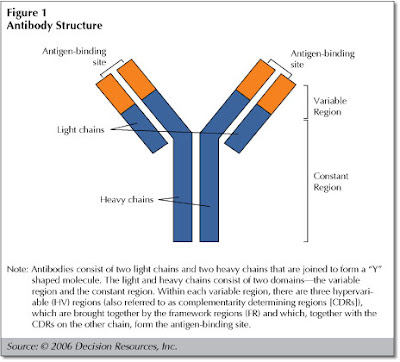

The progression of MAb technology resulted in the following classes of products:

  • Chimeric MAbs: mouse variable region and human constant region
  • Humanized MAbs: mouse hypervariable regions and human framework regions and constant regions
  • Fully human MAbs: human sequences only

Development of fully human MAbs required the invention of special technologies (phage display or the humanized mouse) that do not rely on mouse hybridoma technology.

Among leading fully human MAb companies, Cambridge Antibody Technology utilized phage-display technology, and Abgenix and Medarex used humanized mouse technology.
The great majority of marketed MAb cancer drugs are chimeric or humanized MAbs. The first fully human MAb cancer drug was approved by the FDA in 2006.

The development of MAb enabling technologies began in the early 1980s (early within the period of technological immaturity of MAb drugs). For example, Genentech’s broad Cabilly patents (issued in 1989 and 2001) resulted from the company’s collaboration with academic researchers beginning in the early 1980s. But Genentech’s first MAb products, the antitumor agents Rituxan (codeveloped with Idec) and Herceptin, did not reach the market until 1997 and 1998, respectively. Both are highly successful drugs.

The MAb sector has been characterized by a high degree of litigation over enabling technology patents (e.g., Genentech’s Cabilly patents vs. UCB Celltech’s Boss patent), and a great degree of cross-licensing of enabling technology patents, in part to settle or prevent lawsuits. From this history of technology development, patent disputes and cross-licensing, several MAb sector leaders emerged.

Over the course of the last several years, all of the public biotechnology companies that pioneered therapeutic MAb technology and become leaders in the field have been acquired. The acquisition of Medarex by BMS brings this process to a conclusion.
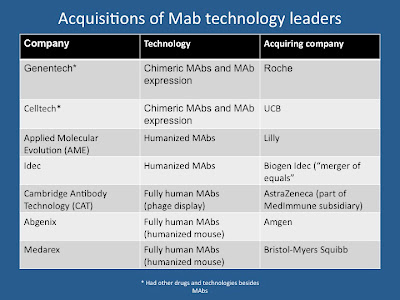

Are there any MAb companies that have yet to be acquired? The Nature Biotechnology article mentions several companies developing antibody conjugates, antibody fragments or antibody mimetics. However, there are also other still-independent firms that have developed proprietary technologies to produce full-length humanized or fully human MAbs. Among these are Facet Biotech (humanized MAbs), and Xoma, MorphoSys, BioInvent, and Dyax (all of which developed fully human MAb platforms based on phage display technology). Of these companies, Dyax is currently focusing on development of its proprietary non-antibody lead product, but also has a pipeline of proprietary research-stage MAbs and partnered research-stage and Phase I MAbs. The other companies are focusing solely on MAbs, and have pipelines of proprietary and partnered MAb drug candidates.

Of these companies, MorphoSys appears to have the strongest technology platform, and has used this platform to craft a unique business model that enables the company to be profitable even though it has not yet marketed a drug. Facet Biotech was spun out of PDL BioPharma last year. PDL, formerly known as Protein Design Labs, is a pioneer in humanized antibody technology, whose technology was used in the development of Genentech’s Herceptin and Avastin. In August 2009, Biogen Idec made an unsolicited offer to acquire Facet, which Facet rejected; the attempt of Biogen Idec to acquire Facet is still ongoing. Biogen Idec has been Facet’s partner since 2005, and the two companies have been codeveloping daclizumab, an anti-IL-2 receptor agent for treatment of multiple sclerosis (currently in Phase II clinical development), and volociximab, an anti-angiogenesis agent for treatment of solid tumors (also currently in Phase II). Except for Facet, none of these companies appears to be a near-term acquisition candidate.

Nevertheless, large pharmaceutical companies are continuing to work on building franchises in biologics, with an emphasis on MAb drugs. This is, for example, a factor in the Merck-Schering Plough and Pfizer-Wyeth mergers. Schering-Plough has had MAb alliances with such companies as MorphoSys and Xoma, and acquired Dutch company Organon (which had a collaboration in MAbs with Dyax) in 2007 in part because of its capabilities in biologics. Merck also acquired GlycoFi in 2006, for its capabilities in yeast-synthesized MAbs and other biologics. The newly merged Merck plans to make biologics a major focus of the company. Similarly, Pfizer acquired Wyeth in part because of its strength in biologics.

Thus, the acquisitions of the leaders in MAb technology represent an important part of a larger picture, the growing emphasis on biologics in large pharmaceutical companies, which have traditionally relied on small-molecule drugs.

Haberman Associates has joined Innovalyst as an Affiliate.

Innovalyst is a North Carolina-based consulting consortium. It is led by four Managing Partners with over 20 years of industrial experience as executives at top-tier pharmaceutical or biotechnology companies. Innovalyst’s Intellectual Capital Advisory Network (ICAN) also includes over 75 Affiliates with an extraordinary breadth and depth of life science business skills.

Since 1997, Haberman Associates has been a member of the Biopharmaceutical Consortium (BPC), a Boston-based life science consulting network. We shall continue to maintain our membership in BPC, and our Boston-area location. However, we shall also expand our network to include Innovalyst. In addition to Haberman Associates, another BPC member, Trilogy Associates (headed by Joseph Kalinowski), is both a member of BPC and an Innovalyst Affiliate. Trilogy relocated to North Carolina in 2008.

Haberman Associates will maintain its primary focus on science and technology strategy, and on new product development via internal R&D and partnering. However, we shall be able to draw on our partners in BPC and Innovalyst to form project teams to take on larger, more complex projects requiring multiple areas of expertise, especially for large pharmaceutical and biotechnology companies. We shall also continue to serve life science clients of all sizes, from start-ups to major corporations.

[Innovalyst ceased to be active as an organization as of February 2013. However, we remain in contact with several Innovalyst Affiliates and Managing Partners, who are available for collaboration with Haberman Associates.]


If you have any questions about Haberman Associates and its expanded consulting network, or would like to discuss your company’s needs, please contact me.

IBC’s Drug Discovery and Development Week was held in Boston on the first week of August, from August 3-6, 2009. This annual event, a highlight of the summer for the Boston biotech community, had always been called “DDT”, for “Drug Discovery Technology” conference. More recently, the name was changed to “Drug Discovery & Development of Innovative Therapeutics World Congress,” but the acronym “DDT” still stuck.

This year, IBC changed the format of the conference, hence the name change. The new format no longer was as technology focused, but emphasized drug discovery and the translation of discovery into clinical studies and onto the market. With our consulting group’s focus on science and technology strategy, biology-driven drug discovery and development, and improving the effectiveness of pharmaceutical and biotechnology R&D, I naturally liked the change in format. IBC also intended the conference to focus on networking and discussion of real drug discovery, scientific research, translational medicine, and business issues. As far as I’m concerned, the conference fulfilled that purpose as well. It was good to meet with friends and colleagues old and new, and to have substantive discussions. Even the booths in the exhibit hall were populated with company executives and researchers, as well as salespeople. It seems that the exhibitors got the point of the new conference format.

A highlight of the conference was the session on oligonucleotide therapeutics, focused on RNAi. At the conference, the RNAi biotech company RXi Pharmaceuticals (Worcester, MA) presented animal study data on its proprietary self-delivered rxRNA (sd-rxRNA) compounds, which are chemically modified RNAi molecules with self-delivering moieties. sd-rxRNAs are designed to be delivered to cells and tissues without a delivery vehicle. In vivo administration resulted in systemic delivery of sd-rxRNAs to the liver. There are many disease indications that could be potentially treated by specifically targeting disease pathways in the liver using oligonucleotide therapeutics such as sd-rxRNAs. sd-rxRNAs are compatible with subcutaneous administration, and thus might be self-administered by patients. The lack of the need for a delivery vehicle also potentially allows for lower manufacturing costs.

I attended the Industry Leadership Forum on RNA therapeutics on August 4. It was like “old home week”, since many of the panelists and attendees had attended (or spoken at) the RNAi conference in Cambridge MA in January at which I had also been a speaker. When I got up to ask a question at the end of the session, panel moderator Jim Thompson of Quark Pharmaceuticals recognized me and asked me a question in return.

One of the key discussions in the Leadership Forum concerned assessing progress in the therapeutic oligonucleotide field. Proof of principle has been achieved for aptamer drugs [pegaptanib (OSI/Eyetech/Pfizer’s Macugen) for treatment of age-related macular degeneration], and for antisense agents [fomivirsen (Isis/ Novartis Ophthalmics’ Vitravene), for treatment of cytomegalovirus retinitis in AIDS patients]. These are the two first oliogonucleotide drugs to reach the market, and both treat ophthalmologic diseases and are delivered locally. Another antisense drug, Isis/Genzyme’s mipomersen is a first-in-class apolipoprotein B (apoB) synthesis inhibitor currently in Phase III trials for treatment of homozygous familial hypercholesterolemia (FH). Miopomersen is one of Isis’ second-generation chemically modified antisense therapeutics. These compounds preferentially traffic to the liver when injected intravenously, without the need for a delivery vehicle.

The panel at the Leadership Forum predicted that an approved oligonucleotide blockbuster drug, which is likely to be a locally delivered or a liver-targeting drug, is about 2-3 years away. The approval of Quark’s systemically delivered kidney-targeting RNAi drug QPI-1002 (for acute kidney injury) may occur soon thereafter. The first microRNA drugs may be approved a year or two after that. Other systemically delivered oligonucleotide drugs that target organs and tissues other than liver or kidney are “a long way off”, and the timing of their appearance is difficult to predict. This is typical of a technologically premature field, as discussed in our earlier blog post. Early formulations of oligonucleotide drugs may also fail in Phase III, thus thwarting the panel’s predictions.

The panelists agreed that it is important to target the “low-hanging fruit” (i.e., products that are locally delivered or target the liver or kidney) first in order to get the momentum of the field going. However, researchers and companies should also look at other targets, especially if they are developing novel enabling technologies in drug delivery and/or in design of therapeutic oligonucleotides with enhanced potency and specificity.

Genetic Engineering & Biotechnology News (GEN) featured my new article, entitled “Overcoming Phase II Attrition Problem”, on the top of Page One of its August 2009 edition.

Here is an image of Page One of the August 2009 issue.

And here am I, at the IBC Drug Discovery and Development Week conference (formerly known as DDT) in Boston, on Tuesday, August 4, holding a copy of the August issue. Thanks to Keri Dostie of IBC for taking this photo.

If you were at the conference, you may have read the article in one of the advance copies of the August GEN that were available there. Or you can look for your own copy, which you should receive in the mail shortly. More immediately, you can read the article by downloading the PDF on our website:

https://biopharmconsortium.com/GEN_PIIAtt_0809.pdf

The article discusses the most important challenge facing the pharmaceutical industry today, the need to improve R&D productivity. It outlines leading-edge strategies for reducing pipeline attrition and for increasing the number of drugs that reach the market and that address unmet medical needs.

If you need a more in-depth exposition, you may have your company order a copy of our May 2009 book-length report, Approaches to Reducing Phase II Attrition, an Insight Pharma Report published by Cambridge Healthtech Institute (CHI). The GEN article is based in part on that report.

You may discuss issues raised by the article or the report by leaving a comment on this blog post.

Thanks are in order to those who helped make the GEN article a success. Four industry executives were quoted in the article– Charles Gombar and Evan Loh of Wyeth, Bruce H Littman of Translational Medicine Associates, and Peter Lassota of Caliper Life Sciences. (Full transcripts of interviews with these and other executives are included in an appendix to the CHI Insight Pharma report.) Drs. Littman and Lassota also reviewed the article prior to publication.

Hearty thanks also to those who served as editors of the article—Laurie Sullivan and Al Doig at CHI and John Sterling and Tamlyn Oliver at GEN. Producing a lead article for GEN (or for other publications) requires an extra level of effort from editors as well as authors, so thanks to all who participated in this effort.